No photos. It's a great course, but it's not the most photogenic.
I didn't feel good or bad, leading into this race. My daily life was so frantic I didn't have time to read the website, but I glanced at the map - new course similar to the old one.
I slept in the back of my car near the halfway mark of the race course.
Before the race, I consumed a quart of Gatorade, two 20oz coffees, and about 8-12oz of water. So about 80+ oz. That's well over half a gallon pre-race.
I ran with a 20oz bottle and didn't bother stopping at the first two aid stations. After that I filled up as usual.
I was feeling pretty decent, but my lungs were full of gunk. I couldn't tell if it was all from my asthma, or if there was still junk from my recent illness with the "crud". I had more respiratory problems than I'm used to having during such a short race.
I screwed this race up. Between the 4th and 5th aid stations is the furthest, and I ran out of fluids. Hard to believe how incredibly quick I dehydrated.
I wonder if my asthma, filling my lungs with fluid, dehydrates me internally faster than a regular runner? The water is still in me, but it's in my lungs, not my blood-stream where my organs could use it.
Anyway, by about 15.5 miles, I was screwed. I basically had to stop racing and go into survival mode. I was suffering.
But I loved it. If I'm on a trail and moving, I'm happy. I'd rather be moving fast, but I'll take slow if I have to. I asked myself if I'd rather be anywhere else? No. You like pain, right? Yeah. You're miserable? Yeah. Then you're happy, right? Yeah. Alright then.
Wow, Tim Parr was incredible. Even Nick Clark and Ryan Burch couldn't reel him in. The new course is HARD! There's a killer steep climb thrown in near the end. How Tim managed this course in 3hr is a mystery to me. The guy's having an incredible year. And this on the heels of leading Red Hot nearly all the way. He's always been fast, but this year he seems to be the one to watch.
Nick Clark is still fast as ever, and seems to do well even when he doesn't have a great day. If anyone shows him any weakness, he'll take the lead. On a good day, with a chosen key race, good luck staying ahead of him.
I spent Sat. night after the race sleeping in my car above Leadville. Gold Burro still gave me the local discount, even though I told them again that I'm not a local. Looks like Pbville hasn't had much snow since I last visited, but it started snowing during the night and blanketed the dirty snow with pristine white stuff.
Sunday, March 13, 2011

Monday, March 7, 2011


Friday, March 4, 2011
A Cold
I've been repeatedly dodging the bullet. Everyone around me has been getting sick with "the crud". When I've gotten sick, I'm just run-down for a day. This one started that same way. For an entire day i had to wonder if I was sick or not. I didn't feel bad, really, but something wasn't right. And all day I just stayed the same. When I drove by Wash Park on a sunny day and saw everyone running, and I felt no urge to join them, I figured I HAD to be sick. As I was going to bed, finally I began to feel it in my chest.
It never got severe. My job requires me to touch a LOT of people's stuff. Keyboards and mice are as filthy as money. Funny how many of us wash our hands at fast-food restaurants, then go to the register to pay and touch money that has passed through 400 people's fingers.
Who knows where I caught it from? One day with less than ideal hydration, maybe not enough sleep, and pow. So even though I wasn't real sick, I took Monday and Tuesday sick-leave to keep from spreading it around. I slept and slept and slept some more.
I ran hard for probably over 13 miles Thursday night, so I'm mostly over it.
Monday, February 21, 2011
Moab Red Hot 55K 2011
I guess I love this race more than I remember.
I got my ass kicked this year. Maybe I'm a masochist, but the more a race kicks my ass, the more I love it. No doubt, the scenery is a lot of why I love it too, though.
I was trying to PR, so I didn't bring a camera.
I averaged about 9:55min/mile pace through the first 19 miles. In order to PR, I needed to average 10:32/mile. Since the finish was far below the mile-19 mark, I figured a PR was in-the-bag. My Timex GPS watch decided to die at this point, with moisture inside it, so I wasn't sure how I was doing the rest of the way.
The race started with a cold, windy rain. The rain stopped, sprinkled, quit, restarted, all day long. The wind never stopped. It was nice when the wind pushed us uphill, but a pain in the ass climbing with a face-wind.
About mile 29, my asthma was kicking up. When I was going through the last aid station, I was gasping like a dieing man and staggering as fast as I could, hoping not to lose my PR, which seemed to be fading. I was so hypoxic, I simply followed the people ahead of me. But they missed a turn. I suddenly noticed them ahead - milling in confusion. Where I was, about 60 feet away, I also couldn't see any pink ribbon markers, no jeep-trail white paint, so I turned around an threw my arms up in the air to warn the people behind us to stop and find markers. We all started running back towards the last marker. Someone saw one, and about 10 of us that went the wrong way got back on course. Some lost only half a minute, but others maybe a few.
I couldn't get my blood-oxygen levels stabilized until about mile 32. In spite of being pretty sure my PR was toast, without a watch, I had to keep pushing 100%.
Finished in 6:07, 3min over previous PR.
In light of my asthma, the missed turn, and the weather, I think I equaled my 2008 PR performance. While disappointing that I missed it, I'm glad that I have a solid race that proves to me that I'm every bit as fast as I was.
An awesome time. At he finish: beer, and bread-bowl potato soup.
Dakota Jones, Tim Parr, Ryan Birch, and Dylan Bowman did an incredible job. Tim led the whole race. Dakota passed Tim near the end. All the people who finished faster than 5hr are freakin' amazing!!
The wind and rain REALLY pummeled the later finishers. OMG, it was crazy. The next morning, the porta-potties at the race start were blown over. Very impressive winds. There wasn't much rain. The Moab area is prone to flash-flooding, and there was never enough rain to make anyone worry about that. It's just that the wind could blow what little rain there was right through all your layers.

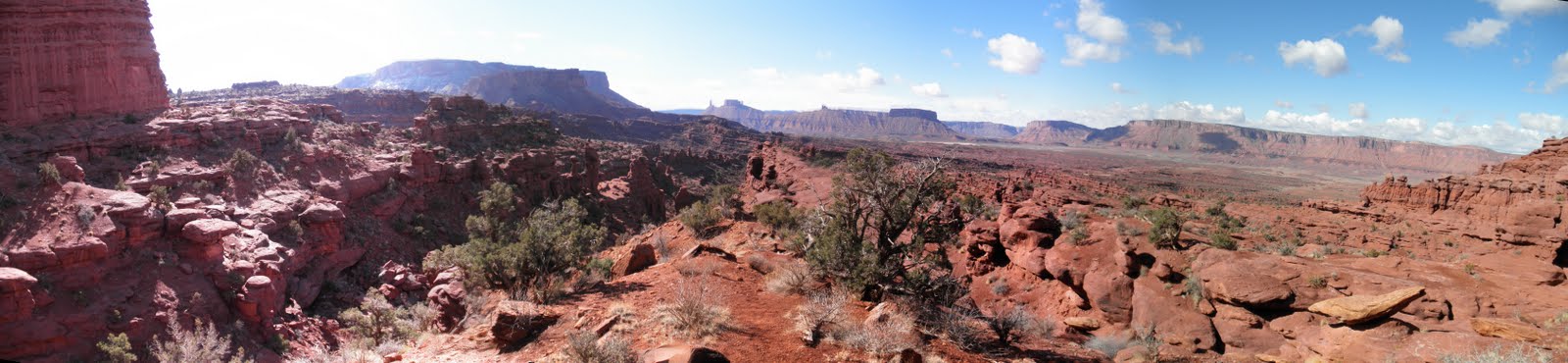
The next day, I did the FIsher Towers trail.

The shady sides of cliffs still had snow, so it was nice to see the canyons, buttes, and cliffs with additional highlights.


I finished with a dark hike up to Hanging Lake, east of Glenwood Springs. It's mostly ice and snow, so I was wearing my snowshoes.
I got my ass kicked this year. Maybe I'm a masochist, but the more a race kicks my ass, the more I love it. No doubt, the scenery is a lot of why I love it too, though.
I was trying to PR, so I didn't bring a camera.
I averaged about 9:55min/mile pace through the first 19 miles. In order to PR, I needed to average 10:32/mile. Since the finish was far below the mile-19 mark, I figured a PR was in-the-bag. My Timex GPS watch decided to die at this point, with moisture inside it, so I wasn't sure how I was doing the rest of the way.
The race started with a cold, windy rain. The rain stopped, sprinkled, quit, restarted, all day long. The wind never stopped. It was nice when the wind pushed us uphill, but a pain in the ass climbing with a face-wind.
About mile 29, my asthma was kicking up. When I was going through the last aid station, I was gasping like a dieing man and staggering as fast as I could, hoping not to lose my PR, which seemed to be fading. I was so hypoxic, I simply followed the people ahead of me. But they missed a turn. I suddenly noticed them ahead - milling in confusion. Where I was, about 60 feet away, I also couldn't see any pink ribbon markers, no jeep-trail white paint, so I turned around an threw my arms up in the air to warn the people behind us to stop and find markers. We all started running back towards the last marker. Someone saw one, and about 10 of us that went the wrong way got back on course. Some lost only half a minute, but others maybe a few.
I couldn't get my blood-oxygen levels stabilized until about mile 32. In spite of being pretty sure my PR was toast, without a watch, I had to keep pushing 100%.
Finished in 6:07, 3min over previous PR.
In light of my asthma, the missed turn, and the weather, I think I equaled my 2008 PR performance. While disappointing that I missed it, I'm glad that I have a solid race that proves to me that I'm every bit as fast as I was.
An awesome time. At he finish: beer, and bread-bowl potato soup.
Dakota Jones, Tim Parr, Ryan Birch, and Dylan Bowman did an incredible job. Tim led the whole race. Dakota passed Tim near the end. All the people who finished faster than 5hr are freakin' amazing!!
The wind and rain REALLY pummeled the later finishers. OMG, it was crazy. The next morning, the porta-potties at the race start were blown over. Very impressive winds. There wasn't much rain. The Moab area is prone to flash-flooding, and there was never enough rain to make anyone worry about that. It's just that the wind could blow what little rain there was right through all your layers.

The next day, I did the FIsher Towers trail.
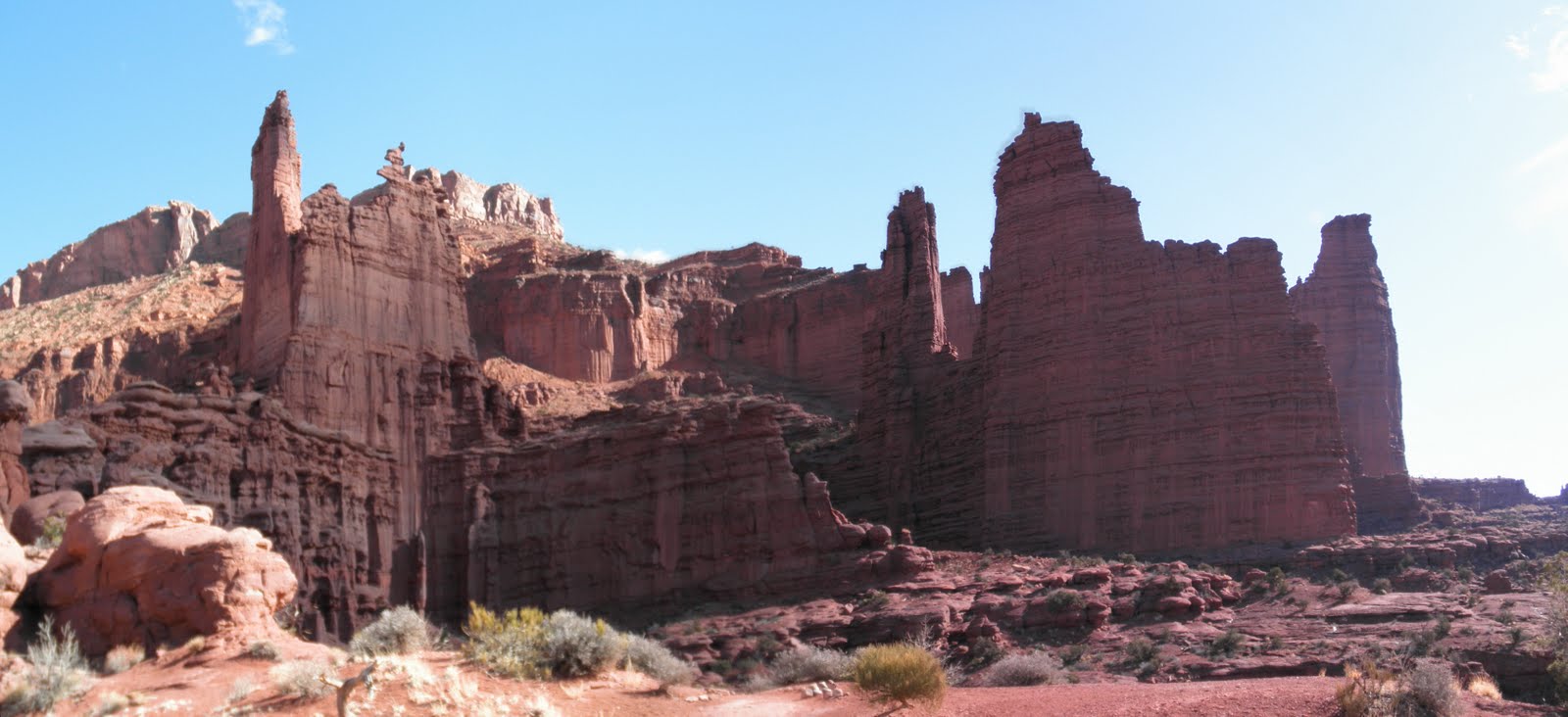
The shady sides of cliffs still had snow, so it was nice to see the canyons, buttes, and cliffs with additional highlights.


I finished with a dark hike up to Hanging Lake, east of Glenwood Springs. It's mostly ice and snow, so I was wearing my snowshoes.
Tuesday, February 15, 2011
More Pbville Training
I went up to Leadville to train in some altitude.

The first run up Ball Mtn, I forgot my camera. Too bad because the lighting was great.
I didn't work so hard getting up Ball, but once I got to the top, I did several hill repeats in the thin air at 12, 300 feet.

It was so beautiful, and I wanted to get two runs in, so I ran back to Leadville, ate a light lunch, grabbed my camera, and ran back up. But not all the way up the last time. And the lighting sucked. So you all missed out on the better views of the day.

The mine at the Leadville Marathon aid station #1, #2, #6, and #7 - yep, we pass this one aid station four times during the race, during July.

The temps were between 12F and 40F all weekend, so nothing like I'm used to in winter in Leadville. In fact, I couldn't tell there was any new snow from the past few weeks, in spite of the fact that Denver got royally dumped on. Snowmobile tracks and snowcat groomed trails abound in the Leadville area. And as you can see, you don't need skis, traction devices, or snowshoes. You could run a hundred miles by looping around over hills and through valleys, on buried trails and roads. The snow causes you to work harder, yet it's easier on your feet.

Saturday, February 5, 2011
Electrolytes & Hydration, Part Last
The main moral of the story. I repeat…
Of course, it is not a perfect world, and a 100-mile running event, at high altitude, with monster 1000ft+ climbs, in weather flipping from cold to heat to cold again, is going to stress your system to the max. Trying to guess what your body needs exactly is nearly impossible. The aid stations are handing out completely erratically mixed beverages. It’s up to each runner to figure it out.
When in doubt, drink a known neutral mixture. This is one of the things having your own drop-bag is essential for. Your drop-bag is a reliable source for controlled-ratio mixtures. If you have a crew, then your bottles need to be marked clearly and your crew instructed clearly which-is-which, and when to hand you what. If you’re in a stupor, your crew needs to figure out if it’s from hypoxia, dehydration, hyponatremia, or low blood sugar.
(As for the latter, have any of you considered using a diabetic glucose tester in the later stages of a race to see if you're heading toward a glycemic crash?)
Many of us have finished a race during summer months and after our sweat dries, we’re covered by a comical streaking of white salt. It might be worth it, to judge the quantity of salt you’re expending, to open an electrolyte capsule and spread the powder on your clean, dry arm. See how much surface-area the contents will cover, leaving it as white and thick as you usually are at the end of these events. Then extrapolate for your body. THAT is how many electrolyte capsules you have coating your body. And that is how much more salt you need to consume (in addition to the usual urine) during a race to stay neutral.
Some of us sweat more than others because we’re all pushing at different intensities, and some of us have lower conditioning. An elite runner won’t burn as many calories to go the same distance, even at a faster pace. Fewer calories means less heat (byproduct of calorie-burn is heat) which in turn means less sweating, which means less breathing, lower rate of dehydration, and less loss of electrolytes. The worse shape you’re in, the more you hemorrhage electrolytes, water, and calories, and the more you build lactic acid. Even small reductions in weight and increases in systemic efficiency have a significant difference in the snow-balling long-term effect it has on your physiology. The lower your rates of expenditure, the easier it is to stay on top of your rates, levels, and ratios. When you end up with a deficit, it can cause serious problems, which lead to DNFs and/or much slower finish-times and unnecessary pain. Add to that, the first-place runners only have to be on their feet for half the time that last-place runners are out there.
Everyone has different strategies for maintaining optimal ratios and levels. Some prefer to keep everything separated into measured doses so they can count calories, electrolytes, and water ounces accurately. Some people can’t do math very well during a race and insist on drinking pre-mixed isotonics. Some drink isotonics without any calories, and then eat measure calories. The simplest way of all, is to mix isotonic sport drinks with adequate calories such that you don’t have to eat anything nor take any electrolyte supplements, but that tends to leave a slight mucous in your mouth. You might not be bothered by such a thing walking around town, but during a race, it’s bothersome. Most racers seem to prefer sport drink that is half-strength, and then eat some food and take some electrolyte supplements.
If you have a history of bad race experiences where you just can’t seem to nail the ratios or levels, there is something you can do.
Warning, this is gross, but it is clinically sound…
At the point of collapse, at the end of your rope, pee into a bottle – like an empty sport-drink bottle. Try to fill either a full quart, or exactly half a quart. Then let it evaporate. When all the water is gone, what is left is mostly salt, including ammonia salts and phosphate soda. Remember blood has about 2tsp of salt per quart (~10gms/qt). Pee reflects what your blood was like at the end of the race. If there’s less than 2tsp/qt, then you needed more electrolyte supplements. If there’s more than that, you took too much.
You can use a scale designed for light-accurate measurements, like a digital food scale that can flip from ounces to grams. Measure the whole bottle with the dried contents, then record the weight. Next, clean and dry the bottle thoroughly and weigh it again. After subtracting your bottle weight, you should have an accurate weight for salt. Then finish by multiplying, if you needed, to extrapolate a full quart.
Don’t ever forget the lesson from the sea – no matter how much sea water you drink, you will die of dehydration. If you pop electrolyte supplements like candy, you are basically drinking sea water and your body will react accordingly.
_____________________
If you take in enough isotonic mixture, your body will keep what it does need and flush out what it doesn’t need, either through your bladder or your bowels.
_____________________
If you take in enough isotonic mixture, your body will keep what it does need and flush out what it doesn’t need, either through your bladder or your bowels.
_____________________
Of course, it is not a perfect world, and a 100-mile running event, at high altitude, with monster 1000ft+ climbs, in weather flipping from cold to heat to cold again, is going to stress your system to the max. Trying to guess what your body needs exactly is nearly impossible. The aid stations are handing out completely erratically mixed beverages. It’s up to each runner to figure it out.
When in doubt, drink a known neutral mixture. This is one of the things having your own drop-bag is essential for. Your drop-bag is a reliable source for controlled-ratio mixtures. If you have a crew, then your bottles need to be marked clearly and your crew instructed clearly which-is-which, and when to hand you what. If you’re in a stupor, your crew needs to figure out if it’s from hypoxia, dehydration, hyponatremia, or low blood sugar.
(As for the latter, have any of you considered using a diabetic glucose tester in the later stages of a race to see if you're heading toward a glycemic crash?)
Many of us have finished a race during summer months and after our sweat dries, we’re covered by a comical streaking of white salt. It might be worth it, to judge the quantity of salt you’re expending, to open an electrolyte capsule and spread the powder on your clean, dry arm. See how much surface-area the contents will cover, leaving it as white and thick as you usually are at the end of these events. Then extrapolate for your body. THAT is how many electrolyte capsules you have coating your body. And that is how much more salt you need to consume (in addition to the usual urine) during a race to stay neutral.
Some of us sweat more than others because we’re all pushing at different intensities, and some of us have lower conditioning. An elite runner won’t burn as many calories to go the same distance, even at a faster pace. Fewer calories means less heat (byproduct of calorie-burn is heat) which in turn means less sweating, which means less breathing, lower rate of dehydration, and less loss of electrolytes. The worse shape you’re in, the more you hemorrhage electrolytes, water, and calories, and the more you build lactic acid. Even small reductions in weight and increases in systemic efficiency have a significant difference in the snow-balling long-term effect it has on your physiology. The lower your rates of expenditure, the easier it is to stay on top of your rates, levels, and ratios. When you end up with a deficit, it can cause serious problems, which lead to DNFs and/or much slower finish-times and unnecessary pain. Add to that, the first-place runners only have to be on their feet for half the time that last-place runners are out there.
Everyone has different strategies for maintaining optimal ratios and levels. Some prefer to keep everything separated into measured doses so they can count calories, electrolytes, and water ounces accurately. Some people can’t do math very well during a race and insist on drinking pre-mixed isotonics. Some drink isotonics without any calories, and then eat measure calories. The simplest way of all, is to mix isotonic sport drinks with adequate calories such that you don’t have to eat anything nor take any electrolyte supplements, but that tends to leave a slight mucous in your mouth. You might not be bothered by such a thing walking around town, but during a race, it’s bothersome. Most racers seem to prefer sport drink that is half-strength, and then eat some food and take some electrolyte supplements.
If you have a history of bad race experiences where you just can’t seem to nail the ratios or levels, there is something you can do.
Warning, this is gross, but it is clinically sound…
At the point of collapse, at the end of your rope, pee into a bottle – like an empty sport-drink bottle. Try to fill either a full quart, or exactly half a quart. Then let it evaporate. When all the water is gone, what is left is mostly salt, including ammonia salts and phosphate soda. Remember blood has about 2tsp of salt per quart (~10gms/qt). Pee reflects what your blood was like at the end of the race. If there’s less than 2tsp/qt, then you needed more electrolyte supplements. If there’s more than that, you took too much.
You can use a scale designed for light-accurate measurements, like a digital food scale that can flip from ounces to grams. Measure the whole bottle with the dried contents, then record the weight. Next, clean and dry the bottle thoroughly and weigh it again. After subtracting your bottle weight, you should have an accurate weight for salt. Then finish by multiplying, if you needed, to extrapolate a full quart.
Don’t ever forget the lesson from the sea – no matter how much sea water you drink, you will die of dehydration. If you pop electrolyte supplements like candy, you are basically drinking sea water and your body will react accordingly.
Electrolytes & Hydration, Part 2
Collation 2
Now let’s collate the other extreme from the sea – travelling in a desert. To get across a desert, travellers used to take in extra quantities of salt before the journey – but not just salt! They have to follow it up with large quantities of water. First salt, to trigger the body to want copious amounts of water, then satiate that thirst immediately after, without over-doing it. This causes your body to temporarily hold extra water, until your body is able to return both quantity and ratio back to the optimal levels. But if you suddenly increase both, then set out across a stifling hot, dry plain, you will probably sweat out much of that excess before your body can pee it out. Thus you have given yourself an extra hour or so of comfort before things start to deteriorate.
Any state of “extra”, with either salt or water, is temporary, but if you don’t have enough water, your body will still rob your dehydrated body of as much water as it can to return the salt ratio back to optimal levels, even if it means dropping the hydration level dangerously below optimal levels. But of course if you’re dehydrated as your body is robbing even more water, then your blood becomes even thicker and it becomes a hopeless vicious cycle that leads to stomach cramps and collapse.
Collation 3
Many of us have heard of the Master Cleanse. This is a strict diet that consists of drinking fresh-squeezed lemonade with grade “B” maple syrup and cayenne pepper mixed in. It’s not delicious, but it’s not as nasty as it sounds. Grade “B” maple syrup is loaded with vitamins, plus fresh lemonade is loaded with vitamin C. Vitamin C is acidic, and cayenne pepper is caustic. Still, the mixture is somewhat mildly acidic and caustic, and causes no discomfort to drink for days on end. The mixture gradually corrodes the “gunk” that can build up on the insides of your intestines. This gunk is what leads to cancers, ulcers, and many other conditions. It will also kill all the bacteria and viruses living in your gut.
So first you loosen up the gunk, then you try to flush it out. Here’s the chemistry lesson in this… You mix 2tsp of salt with 1qt of warm (body-temperature ~98.6F) water, then you guzzle it real fast. If the solution is the same saline ratio as your blood, and you’re not dehydrated, then it will flush through, sometimes violently. It is stressed very clearly to anyone starting the Master Cleanse to be close to a toilet when they do the salt-water flush. It will gush right through from mouth to toilet with surprising speed. This is what blasts the “gunk” off the walls of your intestines during the Cleanse.
No doubt, if you aren’t taking in any other source of salt, then all your daily salt will come from this salt-water Flush – not all the salt will flush out, but the water sure will.
The Master Cleanse achieves bowel-flush through a combination of body-temperature water, empty intestines from no solid food, and the osmosis of salt from the Flush into your slightly hyponatremic system. If you try the Flush when you’re not on the Master Cleanse diet, then there will be plenty of digesting food in the way, so there won’t be any violent results. It takes about two to three days to empty all your intestines. It’s only after the intestines are empty that the Flush truly starts to do its work. The less food and “gunk” in the way, the more violent the Flush will be. When you achieve MC nirvana, clear water runs all the way through you. Nearly all the maple syrup and lemonade absorbs into your blood-stream.
FYI: When finished with the Master Cleanse sessions, you have to rebuild the healthy microbes that are supposed to be in your gut by consuming probiotics for several days. You can’t just start eating regular food again.
I guarantee the MC will cure you of serious flatulence. Flatulence is caused by undigested food (carbs are the worse) getting into your lower intestine. This happens when you over-eat. When the wrong kind of bacteria start colonizing in your lower intestine, then it doesn’t much matter what you eat or how much, you have chronic flatulence. Taking antibiotics is a less-perfect way of killing the bad bacteria, but won’t give you the cleaning.
If you don’t follow the post-MC plan of rebuilding your good-bacteria, and you start dumping hardy foods into your system, then you won’t be able to properly digest. You’ll end up with undigested food in your lower intestine again, which defeats many of the reasons for doing the MC in the first place.
- If your hydration and salt levels are both low, and you guzzle a neutral mix (such as Pedialyte, for example), your body will retain it all – because it needs both.
- If you’re well-hydrated but your salt is low, and you guzzle a neutral mix, your body will retain salt and flush out the water – not necessarily through your bowels, but also through your bladder.
- If you’re dehydrated but your salt is fine…
See the trend? Your body isn’t stupid, even though it sometimes acts that way. It knows what’s best and will do its best to bring all levels back to optimal. This only fails when you don’t give the body the resources it needs to return things to optimal levels.
In a perfect world, all the fluids offered at an ultra event will be mixed at perfectly balanced ratios. It may not taste good, but it will allow your body to adjust to healthy levels, even considering that some people expend either water or salt at different levels. One optimal mixture for all is actually good. If you take in enough optimal mixture, your body will flush out what it doesn’t need, either through your bladder or your bowels. You don’t need to worry about how saline your pee is – your body will make the correct decisions there. It won’t accidentally excrete too much salt through your pee.
If you drink too much water, and you don’t have enough salt, then your body will not be able to drop the excess water very efficiently. This state of hyponatremia can kill you. No one ever developed hyponatremia from drinking an isotonic mix.
On the cellular level, if you add plain water (hypotonic), the cells being saltier, osmosis will cause the cells to fill with water until they burst, thus killing the cells. This is why you shouldn’t try to clean a wound with plain water.
If you subject cells to hypertronic solutions, the cells will get the water sucked out of them, and will shrivel up. Traumatic shrivelling will kill or damage many of them.
Luckily, our stomach and other systems do a fine job of buffering what we consume to introduce substances in a controlled way, so there usually aren’t any traumatic cellular responses. But just the thought of these cellular responses should clue everyone in to how limited their use of water should be during a grueling event, and how important it is to not go hog-wild with the electrolyte supplements.
Subscribe to:
Posts (Atom)